
Move beyond paid ads, cut CAC, and build compounding organic growth with Google, AI Search, and agentic commerce.
- Organic search drives 37× more ecommerce traffic than social media, yet most D2C brands underinvest in it.
- Ecommerce SEO is not the same as regular SEO. It prioritises commercial intent keywords, product and collection page optimisation, and converts search demand into revenue.
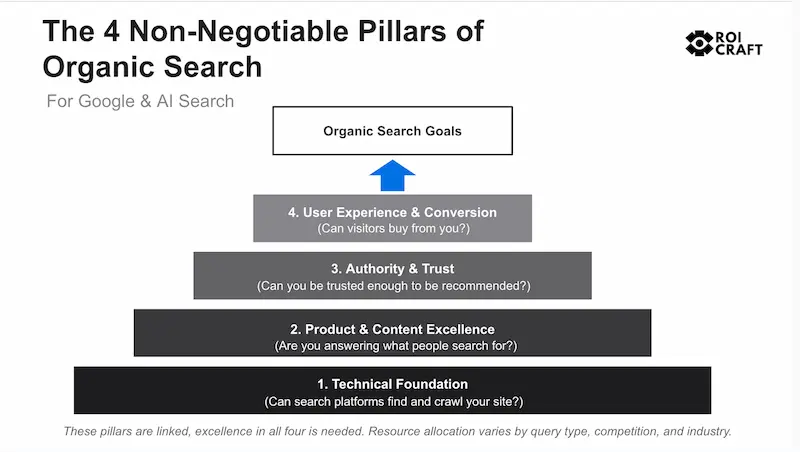
- Four pillars drive sustainable results: Technical Foundation, Product & Content Excellence, Authority & Trust, and User Experience & Conversion.
- Compounding traffic kicks in between months 9–24, when organic visits typically double or triple and customer acquisition cost drops materially.
- AI search engines (ChatGPT, Perplexity, Google AI Overviews) cite authoritative, well structured content. Thin product pages and AI generated copy don’t get cited.
- Done right, ecommerce SEO becomes a permanent business asset, lower CAC, higher margins, and a stronger valuation if you ever sell.
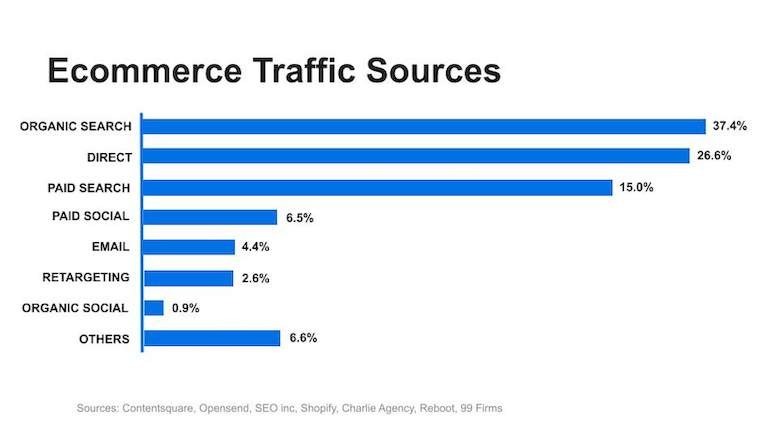
Here’s something most brand owners don’t want to hear: you’re investing 30% of your time on social media that drives around 1% of ecommerce traffic, while ignoring SEO for your online shop, that on average is responsible for over 37% of ecommerce website visits.
In my 18 years specialising in ecommerce SEO, I’ve watched this play out countless times. Founders pour thousands of dollars and hours into Instagram content and paid ads while their product pages sit unoptimised, their category pages have thin content, and they’re invisible in the channels where customers are actively searching to buy.
An outdoor gear brand in our ROI program had a genuinely innovative travel bag and a $74 CAC that was quietly draining their margins. The category pulled strong monthly search volume, thousands of high intent shoppers actively looking for what they sold, but their collection pages sat on page four of Google, their product pages were competing with their own category pages for the same keywords, and they had no citation presence in the AI surfaces now shaping a meaningful share of discovery.
The diagnosis wasn’t a content gap. It was a structural one: the site was telling Google three different stories about what the brand sold, and telling LLMs nothing at all. We rebuilt the taxonomy so each page had a clear job, restructured product content to match how buyers actually compared options in this category, and added the entity signals AI surfaces use to decide which sources to cite. The goal was never to replace paid ads, we kept it doing its job, capturing the customers ready to buy right now. The shift was upstream: organic started feeding the funnel so the business wasn’t hostage to a single paid media channel.
Rankings moved within the first quarter. By month 19, organic had grown from 14% to 63% of new customers, blended CAC had dropped to $21, and a meaningful share of acquisition was running at near zero marginal cost.
Pinpoint the 20 SEO fixes that can unlock more traffic from Google and AI search
Take the free 20 point diagnostic. See your score instantly — most Shopify stores fail 12 or more checkpoints.
We’ve seen this play out over and over again. When ecommerce brands shift focus and measure the real long term return on their channel investment, the results compound in a way that paid media simply can’t replicate. The moment you stop paying for clicks or chasing likes, that channel goes quiet. Ecommerce SEO doesn’t.
Not every ecommerce brand is built for SEO and that’s okay. SEO works best when your brand has something worth searching for. The brands that win with organic search typically have:
- A product with a clear “why” behind it
- An audience that researches before they buy
- They target a niche they can genuinely own
Most brands are sitting on more demand than they realise, they just haven’t set up the processes and tools to uncover and capture it. When you get this right, SEO isn’t just a traffic channel. It’s how you connect with the right customers, solve real problems, and add genuine value.
If you’re in a vertical where competitors are spending on ads and you have the opportunity to reduce your customer acquisition cost, it’s a straightforward decision. Lower CAC means faster growth, stronger margins, and a business that’s harder to compete with. And if you ever plan to sell your company, organic search traffic is one of the most tangible ways to improve your valuation. Brands with compounding organic revenue and a lower CAC are a far more attractive asset than one dependent on paid spend.
What is Ecommerce SEO? (And Why Many Stores Get It Wrong)
Ecommerce SEO is the process of optimising product pages, collection pages, and site architecture so your online store ranks in Google and gets cited by AI search engines like ChatGPT and Perplexity. Unlike traditional SEO, it prioritises commercial intent keywords, conversion, and the unique technical demands of online stores, like duplicate content, product schema, product filters and more. Many brand owners think it’s the same as regular website SEO. It’s not.
You’re not just building organic traffic, you’re optimising every page to convert search intent into paying customers. And when you do it properly, the data is invaluable. Real search demand tells you what thousands of customers are actually looking for, in their own words, before they even land on your website. These insights can inform decisions far beyond marketing, from how you allocate size and colour coverage on a new purchase order, to identifying an unmet customer need that becomes your top selling SKU. This is something a traditional SEO or paid marketing agency can’t offer, and if you outsource it, you miss the golden insights that come from keeping these processes in house.
The common mistakes we see are ones that quietly compound over time: thin content on key pages giving Google nothing to rank, no URL strategy with random changes made throughout the year and no redirects in place, zero long form content leaving large pockets of high intent search demand untouched, duplicate and AI heavy pages lacking real substance, and no deliberate internal linking structure leaving key pages disconnected from Google, LLMs, and customers.
Thanks to AI search, ecommerce SEO is more important than ever. If you’re not on the field, you simply won’t be in the game.
Why SEO is Critical for Ecommerce Success
Organic search drives 37% of all ecommerce traffic on average, making it one of the most valuable channels for online stores. According to Shopify’s own platform data, organic search delivers the highest conversion rate of any traffic source, because the users are actively searching for products with intent, not killing time on social media.
This is why ecommerce SEO isn’t just about rankings. It’s about creating an asset that generates qualified traffic and revenue on autopilot, unlike paid channels that drain your budget and stop the moment you pause campaigns.
When someone searches “organic cotton baby clothes Australia,” they’re not browsing, they’re shopping. They have intent, budget, and they’re ready to buy.
The True Cost of Relying on Paid Ads
One of our member brands selling ocean hats online, relied on paid ads for 71% of sales, spending over $15k per month. They had the margins, but growth had plateaued, net profit was declining, and fixed costs were rising. After implementing our Organic Edge ecommerce SEO tactics, they scaled organic traffic and focused on their top selling products. Over 12 months, their blended CAC dropped from $31 to $15 while monthly sales grew by 300%.
What changed: month over month organic traffic grew, ad spend reduced, CAC improved, and profit margins increased. The Google Analytics data showed a clear upward trajectory that’s still building today.
Once you rank highly, it’s like owning real estate. You’re not paying per click, worried about iOS updates killing your Facebook pixel, or competing in an ad auction where competitors with deeper pockets win.
The Ecommerce SEO Timeline
Based on the multiple stores we’ve scaled past seven figures in monthly organic revenue, here’s the typical ROI timeline:
Up to Months 3
10–25%
Foundation building, traffic increases 10-25%
Months 4–9
25–50%
Rankings improve, traffic often increases 25-50% from baseline
Months 9–24
2–3×
Compounding effect, traffic often doubles or triples
Month 24+
↑↑↑
Sustainable channel that keeps growing as part of everyday operations
The 4 Non Negotiable Pillars of Ecommerce SEO
After helping build sustainable organic growth for hundreds of ecommerce stores across industries, we’ve broken ecommerce SEO down into four core pillars. These aren’t optional, they’re non negotiable if you want sustainable organic growth. Miss any one of them and you’re leaving money on the table. Master all four and you have a compounding organic growth engine.
Your technical foundation answers one critical question: can search engines actually access and understand your site? If Google or LLMs can’t crawl your pages efficiently, everything else is pointless. This covers site speed and Core Web Vitals, mobile first optimisation, crawlability and indexability, clean URL structure, structured data for rich results, XML sitemaps, and HTTPS security. A fast site that can’t be crawled, or a crawlable site that’s slow, both fail to deliver results. Getting this foundation right once will result in you outperforming brands that don’t.
In our Organic Edge Coaching, we audit your site in module one and provide a complete technical SEO checklist.
Stop asking “what page should I create?” and start asking “what problem is my customer trying to solve, and does my site help them solve it?” This is the core of search intent. When you align your pages to what customers are actually searching for, you stop guessing and start capturing demand that already exists.
This pillar covers product page optimisation, collection page optimisation (the most overlooked opportunity in ecommerce SEO), keyword research, and supporting long form content that funnels traffic and authority to key pages. When ChatGPT, Perplexity, or Google’s AI Overviews are asked product questions, they cite pages with comprehensive, authoritative and structured content. Thin product only pages won’t get cited.
Google won’t put you on page one if it doesn’t trust you, especially for commercial and transactional searches where money is involved. Authority is built through backlinks from reputable sites, brand mentions across the web, EEAT signals including reviews, credentials and transparent policies, and digital PR. If two sites have similar technical SEO and content quality, the one with stronger authority signals ranks higher every time. We provide tried and tested ecommerce specific link building and digital PR tactics in our ROI coaching program.
If customers land on your site from Google or an LLM and immediately bounce, you’re not delivering a user experience that aligns with their search intent. Pillar 4 focuses on the measurable page experience signals Google has confirmed as ranking factors: how fast your content loads, how quickly your site responds to interaction, how stable your layout is while loading, and whether your site is mobile friendly and secure.
Strong UX, clear navigation, quality product imagery, trust signals, and compelling CTAs all drive better conversions. Stores converting at 4% instead of 1% don’t need more traffic to double revenue. Where UX and SEO overlap is in technical performance, a fast, stable, mobile friendly online shop, ranks better and sells more. That’s where your time and money should go.
These four core pillars all work together. Miss any one of them, and you’re leaving money on the table. Master all four, and you have a sustainable organic growth engine that compounds over time. 🚀
Ecommerce Keyword Research
Keyword research is where most founders are at one of two extremes, they overthink it or don’t go deep enough.
Keywords are the specific terms people type when searching in Google, or ask conversationally (prompts) through AI tools like ChatGPT and Perplexity. Not all keywords are equal. Someone searching “what are the benefits of organic cotton” has informational intent. Someone searching “organic cotton t-shirts Australia” has commercial intent. When starting your organic growth engine, prioritise commercial and transactional keywords first: product specific terms, category qualifiers, buying modifiers like “buy” and “best,” and commercial questions your customers are actually asking.
Long tail keywords are where the real insight hides. A product page targeting “Black Vitamix 5200 blender” isn’t just an SEO decision, it tells you exactly what your customers want, in their own words. Done properly, keyword research becomes a direct input for demand planning, product development, ad performance, and go to market strategy. We’ve seen it directly inform new product launches that became top sellers, and in one case it influenced a product update for a SKU that now generates 80% of a brand’s revenue, because none of their competitors had identified the customer need hiding in the keyword data.
Common Ecommerce SEO Mistakes That Cost Six Figures
These are some of the common mistakes we see often and the ones that quietly compound into serious revenue loss.
Mistake #1
Using manufacturer descriptions
Duplicate content across hundreds of stores. Start with your best sellers and high margin products first.
Mistake #2
Ignoring collection (category) pages
Category pages consistently drive 10× the traffic of individual product pages. Treat them as strategic SEO assets with unique content targeting broader commercial keywords.
Mistake #3
Poor mobile experience
If your site isn’t mobile friendly, you’re invisible to 70%+ of shoppers. Test on real devices, not just browser emulation.
Mistake #4
No technical SEO foundation
Slow site speed, crawl errors, and missing sitemaps kill rankings before you even start. Use Google Search Console monthly to identify issues.
Mistake #5
Thin product content
A title and bullet points isn’t enough. Aim for 300+ words on your important product pages covering benefits, use cases, and the questions your customers ask.
You would be surprised how many brands doing $200K+/month decide to delete pages and add new ones, wiping out all the authority they had built. When issues are identified and fixed, traffic jumps significantly within weeks.
DIY vs Getting Expert Help: What’s Right For You?
DIY ecommerce SEO works when you have 10–15 hours per week to dedicate consistently, you’re comfortable learning technical concepts, and you’re willing to commit to 6–12 months before judging results. If you give up at month two or three, right before rankings start to move, you miss out on the compounding growth in 12 months. Keep in mind every day you and your team are updating your website, doing so with SEO knowledge is a game changer.
Expert guidance accelerates results when you’ve tried DIY but aren’t seeing traction, your store is doing $30K+ per month and SEO could meaningfully shift your growth trajectory, or you want to avoid costly structural mistakes that take months to undo.
The ROI Craft coaching model is different from a traditional ecommerce SEO agency. Rather than creating dependency on an agency, we teach your team to build and own the capability in house. Nobody knows your products and customers better than you. Once you understand the framework, you’ll make better optimisation and overall business decisions than any agency could. The work you do becomes a permanent asset on your balance sheet and will help you avoid assumptions and make more data driven decisions.
Frequently Asked Questions
DIY costs $100–$500 per month in tools. Agencies typically charge $2,000–$10,000+ per month. Coaching programs like ours run $2,000–$6,000 per month and teach you to build the capability in house, the most cost effective option for brands that want to own their organic channel long term and avoid leaving money on the table or damaging their domain authority (search engine reputation).
You can DIY with 10–15 hours per week and a willingness to learn. In some cases founders start with less time and quickly upgrade the work as a priority once the data is clear. Most founders benefit from expert guidance to avoid costly mistakes and accelerate their timeline. Coaching bridges the gap, you maintain control while getting expert direction.
Pro Tip: If you do ever use an agency for SEO support, you will be in a much better position when you have foundational ecommerce SEO knowledge.
Ecommerce SEO optimises product and category pages for commercial intent keywords, manages duplicate content arising from product variants, and implements structured data markup to generate rich results in search. Critically, it balances ranking performance with conversion optimisation, recognising that traffic means little without sales.
Traditional SEO, by contrast, focuses primarily on driving organic traffic through broader content and authority building strategies, without the same granular focus on product discoverability, site architecture for product collections (catalogues), or the commercial nuance that ecommerce demands.
Shopify, WooCommerce, and BigCommerce all work well when properly configured. Shopify offers the best balance of all round ecommerce tools and can be configured for ease of use and ecommerce SEO for most D2C brands. It’s got clean code, automatic sitemaps, and solid technical fundamentals out of the box. Other enterprise platforms also work well like Shopify Plus, Magento and Salesforce Commerce Cloud.
Most stores see initial improvements in 3–6 months and significant results in 6–12 months. Quick wins like technical fixes can show results in 30–60 days. Timeline depends on domain authority, competition level, and how consistently you execute across all four pillars. See the full ecommerce SEO timeline. Coming Soon.
Ideally yes, but prioritise strategically. Start with best sellers and high margin items first. Unique descriptions help you rank better, convert higher, and differentiate from competitors using manufacturer content.
The costliest: changing URLs, using manufacturer descriptions, ignoring category page optimisation, poor mobile experience, no product schema, thin product content, and treating SEO as a standalone department or a one time project rather than ongoing optimisation effort using data.
The fundamentals align with traditional SEO, create high quality, authoritative content with clear structure, use structured data, answer questions comprehensively, and build trust signals. AI search tools prioritise well structured factual content from trusted sources, exactly what Google’s EEAT framework rewards. It’s more about optimising for both Google and AI search.
Generative Engine Optimization (GEO) is the practice of optimising content so it gets cited by AI search engines like ChatGPT, Perplexity, Claude, and Google AI Overviews. The fundamentals overlap heavily with traditional SEO — clear structure, comprehensive answers, schema markup, and trust signals — but GEO places extra weight on content that LLMs can confidently extract and quote: direct answers, factual statements with sources, FAQ formatting, and specific product details. For ecommerce, this means writing product and collection page content that answers buyer questions head on, not generic marketing copy.
ChatGPT and other LLMs surface brands based on three core signals: content quality and structure on your own site, the volume and consistency of independent third party mentions across the web (review sites, comparison articles, news, niche blogs and forums), and whether your product information is structured with schema markup. If a customer asks ChatGPT “what’s the best [your category] in Australia?” and your brand isn’t being mentioned across reputable third party sources, you won’t be in the consideration set. This is why digital PR, review site presence, and consistent brand mentions matter more than ever for ecommerce.
Product schema is structured data markup that tells search engines and AI tools exactly what’s on your product page — price, availability, ratings, reviews, brand, SKU, and shipping details. It powers rich results in Google (star ratings, prices, stock status) and helps AI shopping agents like ChatGPT Shopping and Perplexity surface your products accurately. Yes, every ecommerce store needs it. Most Shopify themes include basic product schema, but it’s often incomplete or missing high impact fields like AggregateRating and Review markup. Auditing and extending your schema is one of the highest ROI technical SEO tasks for ecommerce brands in 2026.
AI Overviews compress information from multiple sources into a single answer at the top of Google’s results. For purely informational queries, this can reduce click through rates because users get the answer without clicking. But for ecommerce, the impact is more nuanced: AI Overviews still cite product, category, and comparison pages for commercial queries, and being one of the cited sources can drive higher intent traffic that converts at above average rates. The brands that win are those publishing comprehensive, authoritative content with clear structure, schema markup, and unique insights that the AI can confidently quote.
Focus on Google first — but build for both from day one. Google still drives the majority of ecommerce search traffic, and ranking well in Google strongly correlates with being cited in AI search, because LLMs draw from similar quality signals. The good news: you don’t have to choose. The same fundamentals (technical SEO, comprehensive content, structured data, authority signals, and EEAT) work for both. The brands struggling are those still relying on outdated tactics like keyword stuffing or thin AI generated pages, which fail in both channels simultaneously.
Track three layers. At the rankings layer, monitor your target keywords and impressions in Google Search Console. At the traffic layer, watch organic sessions, click through rate, and which pages are growing in Google Analytics 4. At the revenue layer — the one that actually matters — track organic revenue, organic conversion rate, and customer acquisition cost trends month over month. The brands that win measure all three and tie SEO work directly to revenue, not vanity metrics like impressions or top 10 keywords that don’t drive sales.
Start with the technical foundation, then move to your top performing collection and product pages. Specifically: (1) Confirm your site is indexed and free of crawl errors in Google Search Console, (2) Audit Core Web Vitals and fix any pages failing thresholds, (3) Identify your top 10 revenue driving products and collections and rewrite their content with unique, customer focused copy targeting commercial intent keywords, (4) Add complete product schema, and (5) Build internal links from blog content and supporting pages to those money pages. Get these right before chasing backlinks or launching new content campaigns.
Ready To Build Your Ecommerce SEO Foundation?
You now understand what ecommerce SEO is, why it matters, and the four non negotiable pillars that drive results. The question is: will you spend months figuring it out alone, or accelerate your growth with a proven system?
If you’re a Shopify or D2C brand doing $30K–$500K per month and serious about building sustainable organic traffic, ROI Craft’s Organic Edge Coaching provides the exact roadmap.
What you get:
This is not a course. It’s a hands on coaching and implementation program that embeds proven frameworks directly into your business, so you can scale profitably and sustainably.
Not sure if you’re ready? Book a free strategy call. We’ll audit your site, identify your biggest opportunities, and create a custom roadmap — whether you work with us or not.